
Thaiinternetwork ศูนย์รวมอุปกรณ์เน็ตเวิร์ค ไอที ครบวงจร ราคาคุ้ม คุณภาพมาตรฐาน บริการด้วยใจ
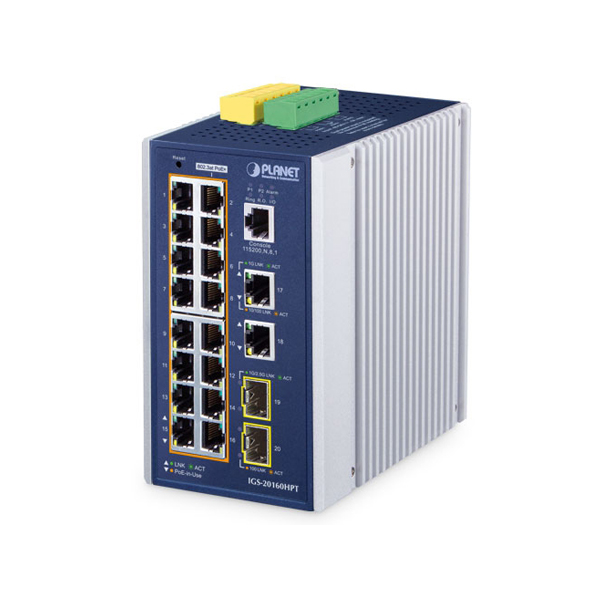
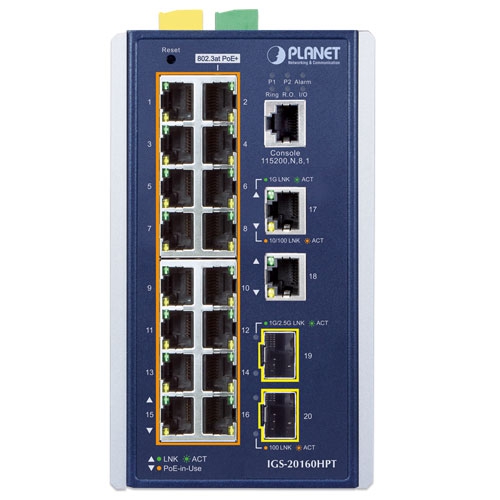
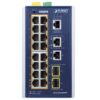
Planet IGS-20160HPT Industrial 16-Port 10/100/1000T 802.3at PoE + 2-Port 10/100/1000T + 2-Port 100/1000X SFP Managed Switch (-40~75 degrees C)
ติดต่อเราเพื่อรับราคาพิเศษสอบถามรายละเอียดจากฝ่ายขายโทร. 084-5534055สอบถามราคาทาง LINELINE: @thaiinternetwork
รหัสสินค้า: IGS-20160HPT
Planet IGS-20160HPT
Industrial 16-Port 10/100/1000T 802.3at PoE + 2-Port 10/100/1000T + 2-Port 100/1000X SFP Managed Switch (-40~75 degrees C)
Advanced Manageable PoE Solution for Hardened Environment
PLANET IGS-20160HPT L3 Industrial Managed PoE+ Switch, featuring 16 10/100/1000BASE-T 802.3at PoE+ ports with each port powering up to 36 watts, 2 10/100/1000BASE-T RJ45 ports, and 2 100/1000/2500BASE-X SFP ports in an IP30 rugged metal case, can be installed in any difficult environment. It provides user-friendly yet advanced IPv6/IPv4 management interfaces, abundant L2/L4 switching functions, Layer 3 OSPFv2 dynamic routing capability, and advanced ITU-G.8032 ERPS Ring technology to improve the rapid self-recovery capability and PLANET intelligent PoE functions for controlling the PoE outdoor IP surveillance and wireless network applications. It is able to operate reliably, stably and quietly in the temperature range from -40 to 75 degrees C.

High Power PoE for Security and Public Service Applications
As the whole system comes with a total 360-watt PoE budget, the IGS-20160HPT is designed specifically to satisfy the growing demand of higher power consuming network PDs (powered devices) such as multi-channel (802.11a/b/g/n) wireless LAN access points, PTZ (pan, tilt, zoom) speed dome network cameras and other PoE network devices.
Intelligent Alive Check for Powered Device
The IGS-20160HPT can be configured to monitor connected PD’s status in real time via ping action. Once the PD stops working and responding, the IGS-20160HPT will recycle the PoE port power and bring the PD back to work. It also greatly enhances the reliability in that the PoE port will reset the PD power, thus reducing administrator’s management burden.

PoE Schedule for Energy Savings
Under the trend of energy savings worldwide and contributing to environmental protection on the Earth, the IGS-20160HPT can effectively control the power supply besides its capability of giving high watts power. The built-in “PoE schedule” function helps you to enable or disable PoE power feeding for each PoE port during specified time intervals and it is a powerful function to help SMBs or enterprises save power and money.

Scheduled Power Recycling
The IGS-20160HPT allows each of the connected PoE IP cameras or PoE wireless access points to reboot at a specific time each week. Therefore, it will reduce the chance of IP camera or AP crash resulting from buffer overflow.

Convenient and Smart ONVIF Devices with Detection Feature
PLANET has developed an awesome feature — ONVIF Support — which is specifically designed for co-operating with video IP surveillances. From the IGS-20160HPT GUI, clients just need one click to search and show all of the ONVIF devices via network application. In addition, clients can upload floor images to the switch series, making the deployments of surveillance and other devices easy for planning and inspection purposes. Moreover, clients can get real-time surveillance’s information and online/offline status; the PoE reboot can be controlled from the GUI.

Redundant Ring, Fast Recovery for Critical Network Applications
The IGS-20160HPT supports redundant ring technology and features strong, rapid self-recovery capability to prevent interruptions and external intrusions. It incorporates advanced ITU-T G.8032 ERPS (Ethernet Ring Protection Switching) technology, Spanning Tree Protocol (802.1s MSTP), and redundant power input system into customer’s industrial automation network to enhance system reliability and uptime in harsh factory environments. In a simple Ring network, the recovery time of data link can be as fast as 10ms.

1588 Time Protocol for Industrial Computing Networks
The IGS-20160HPT is ideal for telecom and Carrier Ethernet applications, supporting MEF service delivery and timing over packet solutions for IEEE 1588 and synchronous Ethernet.
 Layer 3 Dynamic Routing Support
The IGS-20160HPT allows administrators to boost network efficiency by configuring Layer 3 IPv4/IPv6 VLAN static routing manually or automatically through the Routing Information Protocol (RIP) or Open Shortest Path First (OSPF) settings.
- The RIP uses hop count as a routing metric and prevents routing loops by setting a limit on the number of hops allowed in a path from source to destination.
- The OSPF is an interior dynamic routing protocol for autonomous systems based on link state. The protocol creates a database of link states by exchanging link states among Layer 3 switches and then uses the Shortest Path First algorithm to generate a route table based on that database.
Cybersecurity Network Solution to Minimize Security Risks
The IGS-20160HPT supports SSHv2 and TLSv1.2 protocols to provide strong protection against advanced threats. It includes a range of cybersecurity features such as DHCP Snooping, IP Source Guard, ARP Inspection Protection, 802.1x port-based and MAC-based network access control, RADIUS and TACACS+ user accounts management, SNMPv3 authentication, and so on to complement it as an all-security solution.

SMTP/SNMP Trap Event Alert
The IGS-20160HPT provides event alert function to help to diagnose the abnormal device owing to whether or not there is a break of the network connection, or the rebooting response.
 Effective Alarm Alert for Better Protection
The IGS-20160HPT supports a Fault Alarm feature which can alert the users when there is something wrong with the switches. With this ideal feature, the users would not have to waste time finding where the problem is. It will help to save time and human resource.

Digital Input and Digital Output for External Alarm
The IGS-20160HPT supports Digital Input and Digital Output on its front panel. This external alarm enables users to use Digital Input to detect and log external device status (such as door intrusion detector), and send event alarm to the administrators. The Digital Output could be used to alarm the administrators if the IGS-20160HPT port shows link down, link up or power failure.

Robust Layer 2 Features
The IGS-20160HPT can be programmed for advanced switch management functions such as dynamic port link aggregation, Q-in-Q VLAN, private VLAN, Rapid Spanning Tree Protocol, Layer 2 to Layer 4 QoS, bandwidth control and IGMP snooping. The IGS-20160HPT provides 802.1Q tagged VLAN, and the VLAN groups allowed will be maximally up to 4K. Via aggregation of supporting ports, the IGS-20160HPT allows the operation of a high-speed trunk combining multiple ports. It enables a maximum of up to 10 trunk groups with 16 ports per trunk group, and supports fail-over as well.

Powerful Security
The IGS-20160HPT offers comprehensive Layer 2 to Layer 4 Access Control List (ACL) for enforcing security to the edge. It can be used to restrict network access by denying packets based on source and destination IP address, TCP/UDP ports or defined typical network applications. Its protection mechanism also comprises 802.1x Port-based and MAC-based user and device authentication. With the private VLAN function, communication between edge ports can be prevented to ensure user privacy. The network administrators can now construct highly-secure corporate networks with considerably less time and effort than before.
Efficient Management
For efficient management, the IGS-20160HPT Managed Ethernet Switch is equipped with console, Web and SNMP management interfaces. With the built-in Web-based management interface, the IGS-20160HPT offers an easy-to-use, platform-independent management and configuration facility. For text-based management, the IGS-20160HPT can be accessed via Telnet and the console port. Moreover, it also offers secure remote management via any standard-based management software by supporting SNMPv3 connection which encrypts the packet content at each session.

Remote Management Solution
PLANET’s Universal Network Management System (UNI-NMS) and CloudViewer/CloudViewerPro app support IT staff by remotely managing all network devices and monitoring PDs’ operational statuses. Thus, they’re designed for both the enterprises and industries where deployments of PDs can be as remote as possible, without having to go to the actual location once a bug or faulty condition is found. With the UNI-NMS or CloudViewer/CloudViewerPro app, all kinds of businesses can now be speedily and efficiently managed from one platform.

Modbus TCP Provides Flexible Network Connectivity for Factory Automation
With the supported Modbus TCP/IP protocol, the IGS-20160HPT can easily integrate with SCADA systems, HMI systems and other data acquisition systems in factory floors. It enables administrators to remotely monitor the industrial Ethernet switch’s operating information, port information and communication status, thus easily achieving enhanced monitoring and maintenance of the entire factory.
Flexibility and Extension Solution
The two mini-GBIC slots built in the IGS-20160HPT support triple speed, 100BASE-FX, 1000BASE-SX/LX and 2500BASE-SX/LX SFP (Small Form-factor Pluggable) fiber-optic modules, meaning the administrator now can flexibly choose the suitable SFP transceiver according to not only the transmission distance but also the transmission speed required. The distance can be extended from 300 meters to 2km (multi-mode fiber) and up to 10/20/30/40/60/70/80/120 kilometers (single-mode fiber or WDM fiber). They are well suited for applications within the enterprise data centers and distributions.

Intelligent SFP Diagnosis Mechanism
The IGS-20160HPT supports SFP-DDM (Digital Diagnostic Monitor) function that greatly helps network administrator to easily monitor real-time parameters of the SFP, such as optical output power, optical input power, temperature, laser bias current, and transceiver supply voltage.

Specifications :
| Hardware Specifications | |
| Version | 4 |
| Copper Ports | 18 10/100/1000BASE-T RJ45 auto-MDI/MDI-X ports |
| SFP/mini-GBIC Slots | 2 1000/2500BASE-X SFP interfaces (Port-19 and Port-20) Compatible with 100BASE-FX SFP |
| PoE Injector Port | 16 ports with 802.3at/af PoE injector function with Port-1 to Port-16 |
| Console | 1 x RJ45-to-RS232 serial port (115200, 8, N, 1) |
| Reset Button | < 5 sec: System reboot > 5 sec: Factory default |
| ESD Protection | 6KV DC |
| Enclosure | IP30 aluminum case |
| Installation | DIN-rail kit and wall-mount kit |
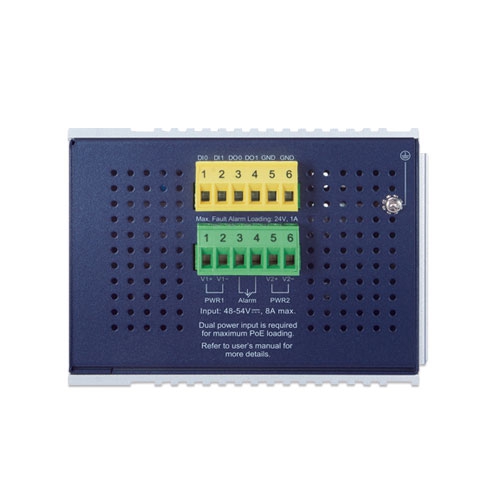
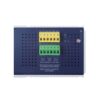
| Connector | Removable 6-pin terminal block for power input Pin 1/2 for Power 1, Pin 3/4 for fault alarm, Pin 5/6 for Power 2 Removable 6-pin terminal block for DI/DO interface Pin 1/2 for DI 1 & 2, Pin 3/4 for DO 1 & 2, Pin 5/6 for GND |
| Alarm | One relay output for power failure. Alarm relay current carry ability: 1A @ 24V DC |
| DI, DO | 2 digital input (DI) Level 0: -24V~2.1V (±0.1V) Level 1: 2.1V~24V (±0.1V) Input load to 24V DC, 10mA max. 2 digital output (DO) Open collector to 24V DC, 100mA max. |
| Dimensions (W x D x H) | 86.8 x 107.3 x 152 mm |
| Weight | 1548g |
| Power Requirements | Dual 48~54V DC (>51V DC for PoE+ output recommended) |
| Power Consumption | Max.18.8 watts/64BTU (Power on without any connection) Max. 413 watts/1409BTU (Full loading with PoE function) |
| LED Indicator | System: Power 1 (Green) Power 2 (Green) Fault Alarm (Red) Ring (Green) Ring Owner (Green) DIDO (Red) Per 10/100/1000T RJ45 PoE+ Ports: PoE-in-Use (Amber) LNK/ACT (Green) Per 10/100/1000T RJ45Ports: 1000 LNK/ACT (Green) 100 LNK/ACT (Amber) Per SFP Interface: 10/100 LNK/ACT (Amber) 1G/2.5G LNK/ACT (Green) |
| Switching | |
| Switch Architecture | Store-and-Forward |
| Switch Fabric | 46Gbps/non-blocking |
| Throughput (packet per second) | 34.2Mpps@ 64 bytes packet |
| Address Table | 32K entries, automatic source address learning and aging |
| Shared Data Buffer | 32Mbits |
| Flow Control | IEEE 802.3x pause frame for full duplex Back pressure for half duplex |
| Jumbo Frame | 10K bytes |
| Power Over Ethernet | |
| PoE Standard | IEEE 802.3at Power over Ethernet Plus/PSE |
| PoE Power Supply Type | End-span |
| PoE Power Output | IEEE 802.3af Standard Per port 48V~51V DC (depending on the power supply), max. 15.4 watts IEEE 802.3at Standard Per port 51V~54V DC (depending on the power supply), max. 36 watts |
| Power Pin Assignment | 1/2(+), 3/6(-) |
| PoE Power Budget | 48V Power input 240W maximum (depending on power input) 52~54V Power input Single power input: 240W maximum (depending on power input) Dual power input: 360W maximum (depending on power input) ※Dual power input must be the same as DC voltage, like dual 54V |
| Max. Number of Class 2 PDs | 16 |
| Max. Number of Class 3 PDs | 16 |
| Max. Number of Class 4 PDs | 10 |
| Layer 3 Functions | |
| IP Interfaces | Max. 128 VLAN interfaces |
| Routing Table | Max. 128 routing entries Max. 4K H/W routing table entries |
| Routing Protocols | IPv4 RIPv1/v2 IPv4 OSPFv2 IPv4 hardware static routing IPv6 OSPFv3 hardware static routingIPv4 OSPFv2 dynamic routing |
| Layer 2 Function | |
| Port Configuration | Port disable/enable Auto-negotiation 10/100/1000Mbps full and half duplex mode selection Flow control disable/enable Power saving mode control |
| Port Status | Display each port’s speed duplex mode, link status, flow control status, auto negotiation status, trunk status |
| Port Mirroring | TX / RX / Both Many-to-1 monitor RMirror – Remote Switched Port Analyzer (Cisco RSPAN) Supports up to 5 sessions |
| VLAN | IEEE 802.1Q tag-based VLAN IEEE Q-in-Q tunneling Private VLAN Edge (PVE) MAC-based VLAN Protocol-based VLAN VLAN Translation Voice VLAN MVR (Multicast VLAN Registration) GVRP Up to 4K VLAN groups, out of 4094 VLAN IDs |
| Link Aggregation | IEEE 802.3ad LACP/static trunk Supports 10 trunk groups with 16 ports per trunk group |
| Spanning Tree Protocol | IEEE 802.1D Spanning Tree Protocol IEEE 802.1w Rapid Spanning Tree Protocol IEEE 802.1s Multiple Spanning Tree Protocol Supports 7 MSTP instances BPDU Guard, BPDU filtering and BPDU transparent Root Guard |
| IGMP Snooping | IPv4 IGMP (v1/v2/v3) snooping IPv4 IGMP querier mode support Up to 255 multicast groups |
| MLD Snooping | IPv6 MLD (v1/v2) snooping IPv6 MLD querier mode support Up to 255 multicast groups |
| Bandwidth Control | Per port bandwidth control Ingress: 500Kb~1000Mbps Egress: 500Kb~1000Mbps |
| Ring | Supports ERPS, and complies with ITU-T G.8032 Recovery time < 10ms @ 3 nodes Recovery time < 50ms @ 16 nodes Supports Major ring and sub-ring |
| Synchronization | IEEE 1588v2 PTP (Precision Time Protocol) Peer-to-peer transparent clock End-to-end transparent clock |
| QoS | Traffic classification based, strict priority and WRR 8-level priority for switching Port number 802.1p priority 802.1Q VLAN tag DSCP/TOS field in IP packet |
| Security Functions | |
| Access Control List | IP-based ACL/MAC-based ACL ACL based on: MAC Address IP Address Ethertype Protocol Type VLAN ID DSCP 802.1p Priority Up to 256 entries |
| Security | Port Security IP source guard, up to 512 entries Dynamic ARP inspection, up to 1K entries Command line authority control based on user level Static MAC address, up to 64 entries |
| AAA | RADIUS client TACACS+ client |
| Network Access Control | IEEE 802.1x port-based network access control MAC-based authentication Local/RADIUS authentication |
| Switch Management | |
| Basic Management Interfaces | Console; Telnet; Web browser; SNMP v1, v2c |
| Secure Management Interfaces | SSHv2, TLS v1.2, SNMP v3 |
| System Management | Firmware upgrade by HTTP protocol through Ethernet network Configuration upload/download through HTTP Remote syslog System log LLDP protocol NTP PLANET Smart Discovery Utility PLANET NMS system PLANETCloudViewer/CloudViewerPro |
| Event Management | Remote syslog Local system log SMTP |
| ONVIF | ONVIF device discovery ONVIF device monitoring Floor Map |
| SNMP MIBs | RFC 1213 MIB-II RFC 2863 IF-MIB RFC 1493 Bridge MIB RFC 1643 Ethernet MIB RFC 2863 Interface MIB RFC 2665 Ether-Like MIB RFC 2737 Entity MIB RFC 2819 RMON MIB (Groups 1, 2, 3 and 9) RFC 2618 RADIUS Client MIB RFC 3411 SNMP-Frameworks-MIB RFC 4292 IP Forward MIB RFC 4293 IP MIB RFC 4836 MAU-MIB IEEE 802.1X PAE LLDP Power over Ethernet MIB |
| Standards Conformance | |
| Regulatory Compliance | FCC Part 15 Class A, CE |
| Stability Testing | IEC60068-2-32 (free fall) IEC60068-2-27 (shock) IEC60068-2-6 (vibration) |
| Standards Compliance | IEEE 802.3 10BASE-T IEEE 802.3u 100BASE-TX/100BASE-FX IEEE 802.3z Gigabit SX/LX IEEE 802.3ab Gigabit 1000T IEEE 802.3x flow control and back pressure IEEE 802.3ad port trunk with LACP IEEE 802.1D Spanning Tree Protocol IEEE 802.1w Rapid Spanning Tree Protocol IEEE 802.1s Multiple Spanning Tree Protocol IEEE 802.1p Class of Service IEEE 802.1Q VLAN tagging IEEE 802.1ad Q-in-Q VLAN stacking IEEE 802.1X Port Authentication Network Control IEEE 802.1ab LLDP IEEE 802.3af Power over Ethernet IEEE 802.3at Power over Ethernet Plus IEEE 802.3ah OAM IEEE 802.1ag Connectivity Fault Management (CFM) IEEE 1588 PTPv2 RFC 768 UDP RFC 783 TFTP RFC 791 IP RFC 792 ICMP RFC 2068 HTTP RFC 1058 RIP v1 RFC 2453 RIP v2 RFC 1112 IGMP v1 RFC 2236 IGMP v2 RFC 3376 IGMP version 3 RFC 2710 MLD version 1 RFC 3810 MLD version 2 RFC 2328 OSPF v2 RFC 2740 OSPF v3 ITU G.8032 ERPS Ring ITU-T Y.1731 Performance Monitoring |
| Environment | |
| Operating Temperature | -40 ~ 75 degrees C |
| Storage Temperature | -40 ~ 85 degrees C |
| Humidity | 5 ~ 95% (non-condensing) |

สินค้าที่เกี่ยวข้อง
-

Link UFC9696MD F.O. Armored, Multi-Tube 96 Core, OS2, Double Jacket
฿79.44 บาท (รวมภาษี)สั่งซื้อสินค้าF.O. Armored, Multi-Tube 96 Core, OS…
-

Link UFC4304 F.O. Outdoor / Indoor, All-Dielectric 4 Core, LSZH-FR, OM3
฿37.38 บาท (รวมภาษี)สั่งซื้อสินค้าF.O. Outdoor / Indoor, All-Dielectri…
-

Link UFC9306 F.O. Outdoor / Indoor, All-Dielectric 6 Core, LSZH-FR, OS2
฿18.69 บาท (รวมภาษี)สั่งซื้อสินค้าF.O. Outdoor / Indoor, All-Dielectri…
-

Link UFC4306 F.O. Outdoor / Indoor, All-Dielectric 6 Core, LSZH-FR, OM3
฿42.06 บาท (รวมภาษี)สั่งซื้อสินค้าF.O. Outdoor / Indoor, All-Dielectri…